Content Strategy
Do you also look at content now and think... is this even real?
By Stephany Riano · 29 October 2026 · 8 min read
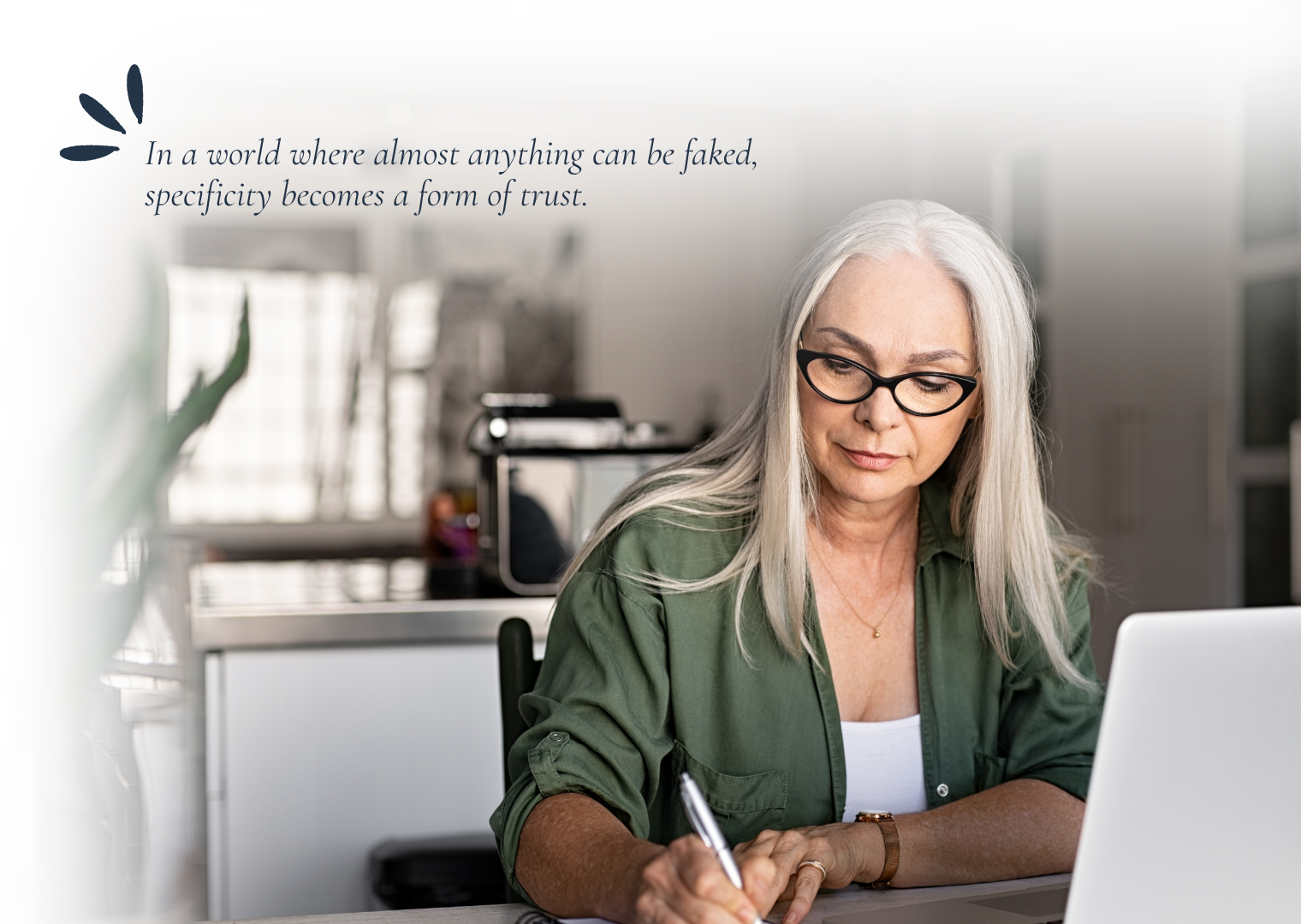
Do you also sometimes look at something online and think...
Is this even real?
The review?
The product picture?
The person in the video?
The story behind the post?
We are living in a moment where almost anything can look convincing.
And that creates a strange problem for companies.
Because if everything can be polished, generated, edited and multiplied in seconds, perfection stops being very impressive.
Sometimes it even creates suspicion.
And apparently, we are not imagining it.
In 2026, Gartner found that 68% of surveyed consumers frequently wonder whether the content and information they see is real.
Another Gartner survey found that 65% think brands are producing too much AI generated content, while 57% said that this has made them less trusting of brand messaging overall.
Soooo... what do we do with that as companies?
My answer is probably not another content trend.
Connect from what is real, not from what looks perfect.
We do not have a content shortage. We have an attention problem
There is so much content.
More posts.
More videos.
More newsletters.
More ads.
More images.
More everything.
AI has made producing content easier, which can be incredibly useful.
But easier production also means we are producing more and more of it.
And the person on the other side still has the same number of hours in the day.
HubSpot reports that 83.5% of marketers are now expected to produce more content.
At the same time, 77% of social media marketers say authenticity matters more than production value.
Interesting combination, no?
Create more.
But please make it feel more real.
That is exactly why I do not think the answer is simply producing more polished content.
The answer is giving people a reason to care about yours.
Your company has a life too
I think companies often make a mistake when they communicate.
They start acting like companies.
Suddenly the language becomes formal, vague and strangely empty.
We are innovative.
We are customer focused.
We deliver excellence.
Okay... but who are you?
A company has a beginning.
It has people.
It has moments that changed it.
It has things it cares about, things it refuses to do and things it wants to improve.
It has a personality, even if nobody has written it down yet.
Your company does not need to pretend to be human. It already contains humans.
The job of communication is to stop hiding them.
So what does “real” actually mean?
Real does not mean posting everything.
It does not mean filming every meeting or turning your team into influencers.
And it definitely does not mean becoming unprofessional.
For me, real means specific enough to be believed.
A real opinion.
A real reason.
A real person.
A real example.
A real choice your company made because of what it believes.
That can work on your website, LinkedIn, Instagram, a newsletter, a sales presentation or almost any other kind of company communication.
Here are three places I would start.
1. Communicate your values, but please tell me what they actually mean
Lots of companies have values.
Trust.
Innovation.
Quality.
Sustainability.
People first.
Nice.
Now tell me what that changes.
Why does your company do what it does?
What are you trying to achieve besides revenue, growth or creating jobs?
Who benefits when you do your work well?
Does your company make something easier, safer, clearer, healthier, more accessible, more beautiful or more sustainable?
What kind of impact do you want to have on a customer, an industry or your community?
That is where values become interesting.
Do not just say what you value.
Show me what that value makes you do.
A value becomes believable when I can see it in a decision.
2. Tell me something I could only learn from you
This is my favourite test for generic brand communication.
Could your competitor copy this sentence and publish it tomorrow?
If yes, keep going.
Tell me something particular.
“We do this differently because...”
“We stopped doing this because...”
“We learned this after...”
“Our customers kept asking us...”
“This is something we care about more than most companies in our industry...”
Specific details create personality.
And personality gives people something to remember.
You do not need a dramatic founder story.
Sometimes one honest sentence about why you do something differently is much stronger than an entire About Us page.
3. Show the people who make the company exist
This one sounds obvious, but I still see companies hiding their best proof of humanity.
Their people.
Show them.
Be proud of them.
Tell us what they know.
Let them explain something.
Share the person behind a project, a customer experience, an idea or a piece of expertise.
No, every employee does not need to become a content creator.
But a company should not look like it magically operates without humans.
Your team is not decoration for the careers page.
They are part of the reason customers experience the company the way they do.
Maybe imperfect is becoming more valuable
We spent years learning how to make brands look polished.
Now technology can produce polished at incredible speed.
So perhaps the interesting question is changing.
Not:
How can we look more perfect?
But:
How can someone recognise us?
How can they believe us?
How can they feel that there are actual people, decisions, values and experiences behind what they are seeing?
I am not against AI. At all.
Use it to organise ideas, improve workflows, analyse information and remove repetitive work.
But do not let efficiency erase the parts that make your company yours.
In a world where almost anything can be faked, specificity becomes a form of trust.
So before you ask what trend your company should follow next, maybe ask something simpler.
What is true about us that nobody else can copy?
Start there. 🤓
Let’s work together
Looking for stronger SEO, a better website or support with your digital marketing? I’d be happy to talk.
Let’s work together